
I devised a way of saving myself hours (well, possibly minutes) by wearing t-shirts with slogans of things I say often enough in meetings, that I think of them as ‘Sarah-isms’. For example, a very common on is ‘have you thought about the content?’
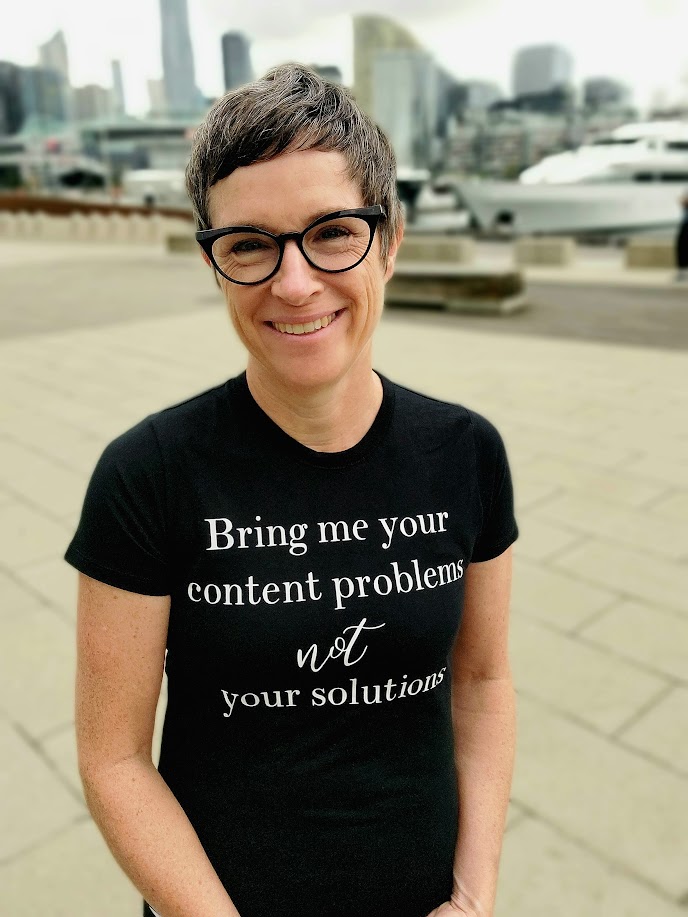
Almost as common is when someone comes to me with a fully formed solution, convinced it’s what they need. For example, “We need a new webpage” or “Let’s create a portal for this information.” Sometimes it’s even, “Here’s a piece of content — just publish it.” And while these suggestions might seem helpful, they often aren’t rooted in a clear understanding of the actual problem they’re trying to solve.
When you come to me with a pre-baked solution, you’re bypassing the most critical step in the process — identifying the real issue at hand. As a content strategist, my job is to ensure that what we create is useful and that we’re measuring how the success of the solution. And that starts with defining the problem, not jumping straight to a solution.
The cost of the wrong solution
I have talked before about how writing’s not the hard part of content, and one of the most challenging parts of my work is undoing efforts that others have poured hours into. For instance, I’ve had pages and pages of content handed to me for publication, only to realise that adding a single sentence to an existing page would have solved the issue more effectively. Similarly, I’ve lost count of how many times I’ve been asked to create FAQ pages with questions that no one is actually asking.
Sometimes, these premature solutions come in the form of beautifully designed layouts. A designer might hand me a series of boxes filled with placeholder text or Lorem Ipsum, expecting me to retrofit content into their design. But content isn’t an afterthought — it’s the foundation. When you start with a design instead of the content, you risk creating something that looks great but doesn’t address the user’s needs or solve the underlying problem.
The emotional energy of “No”
Saying “no” to someone’s hard work is never easy. When I’m faced with poorly thought-out solutions that have already been “approved” by others, there’s a delicate balance to strike. I have to explain why their approach won’t work, while also redirecting them toward a better path. It’s not just about undoing work — it’s about undoing emotional investment, which is a far trickier task.
What problem are you trying to solve?
When you bring me your problem, not your solution, we open up possibilities. Instead of shoehorning content into a pre-existing framework, we can:
- Clarify the goal: What are we trying to achieve? Is it increasing user engagement, reducing customer support queries, or something else entirely?
- Define success: How will we measure whether we’ve solved the problem? Metrics give us a clear direction and help avoid unnecessary work.
- Explore options: Often, the best solution isn’t what you initially imagined. Maybe it’s a tweak to existing content or a shift in how information is presented. It might not be the most glamourous or shiny solution that is the best way forward.
If you’re working with a content designer or strategist, resist the urge to come armed with solutions. Instead, share the problem you’re facing. Be open to exploring ideas together. Because the best content solutions don’t start with a webpage, a portal, or a dummy design. They start with a problem and a commitment to solving it the right way. In other words, bring me your content problems, not your content solutions.

 Content philosophy
Leave a comment